
How to Tell the Difference between Independent and Dependent Clauses
Table of Contents
To score well on the SAT, it’s important to clearly understand the difference between independent and dependent clauses. Still, many students find the difference hard to grasp.
This article aims to provide a clear and simple explanation of what independent and dependent clauses are, and how they differ.
But before we discuss independent and dependent clauses, it’s helpful to review what a clause is.
Quick Summary
In English grammar, a clause is a group of words that contains both a subject and a verb. Clauses come in two main types:
- Independent clause: it can stand alone as a complete sentence.
- Dependent clause: it cannot stand on its own and needs an independent clause to complete its meaning.
Here are simple examples of each type.
Independent clause
I like cats.
“I” is the subject, “like” is the verb, and “cats” is the object. Because the sentence is complete by itself, it functions as an independent clause.
Dependent clause
Though I like cats, I am allergic to cats.
The part “Though I like cats” is a dependent clause because it cannot stand alone as a full sentence; it leaves the meaning unfinished without the main clause that follows.
What is a Clause?
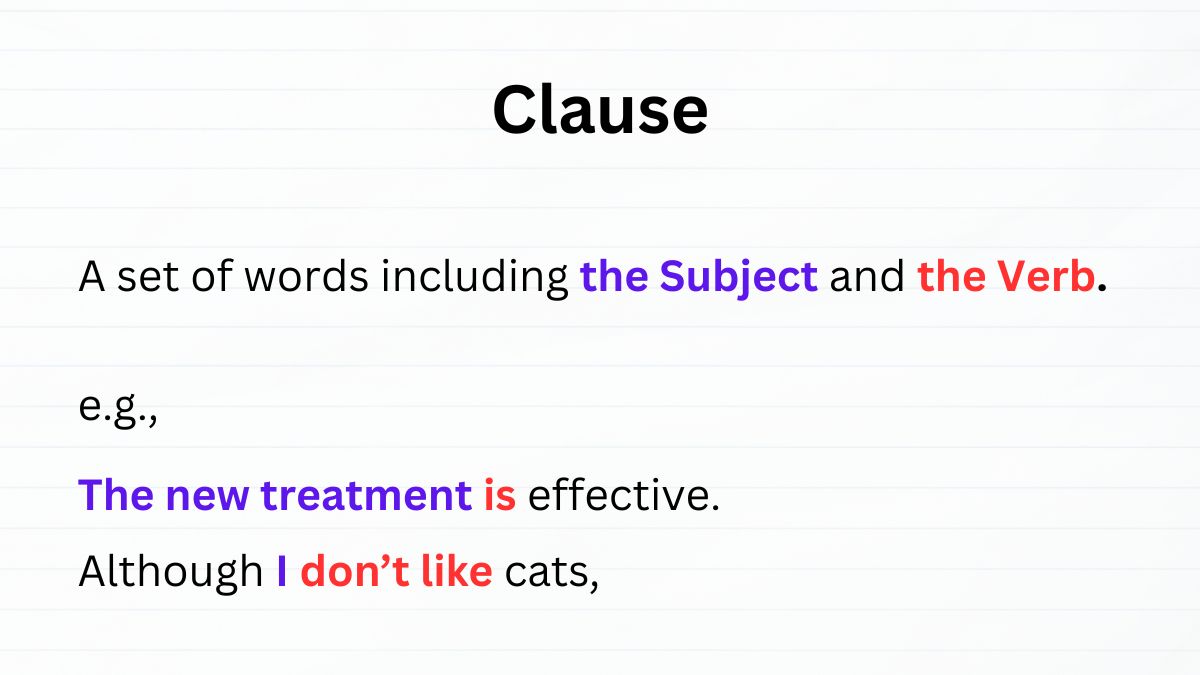
Simply saying, a clause is a group of words that contains both a subject and a verb. For example,
The legislative bill has passed the Congress.
This is a clause because it has a subject (“the legislative bill”) and a verb (“has passed”).
At first glance, you might think a clause is the same as a complete sentence. But it depends on the structure.
Some clauses are independent clauses, which can stand alone as complete sentences. Others are dependent clauses, which cannot stand alone and need more information to form a complete thought.
Now, let’s take a look at how independent and dependent clauses work differently.
Independent Clause
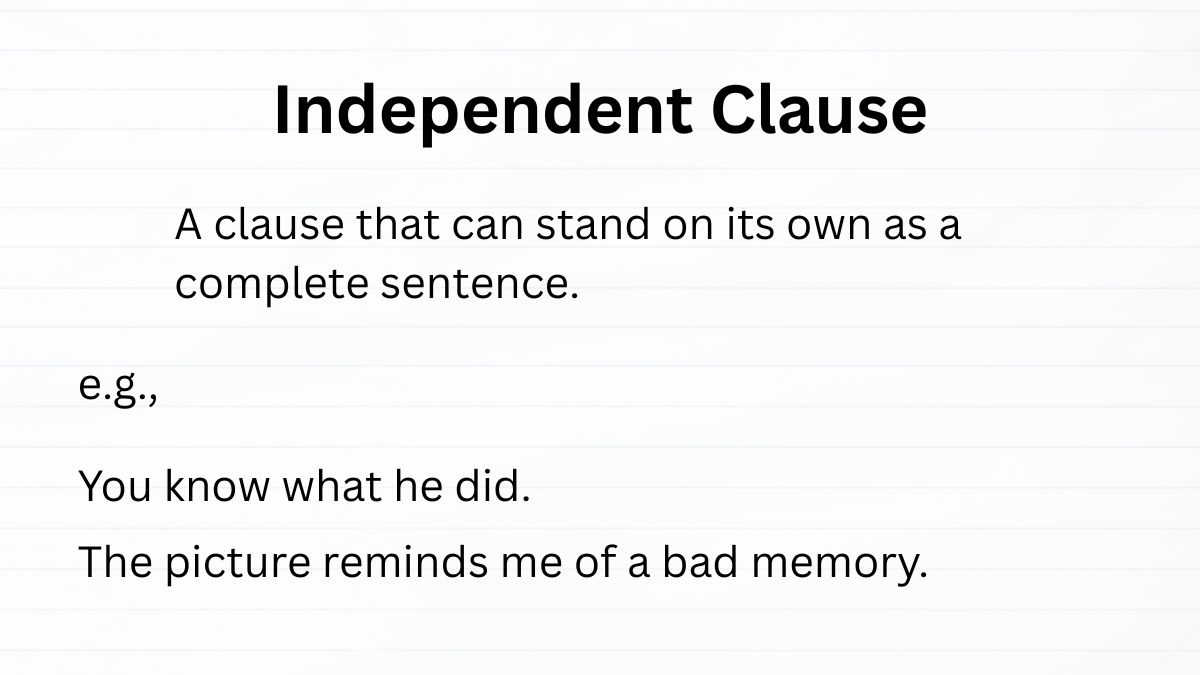
An independent clause is also called a complete sentence because it expresses a complete thought on its own.
A boy was making a sand castle.
This is an independent clause because it forms a complete sentence by itself. If we break it down grammatically, we get the following:
- Subject: A boy
- Verb: was making
- Object: a sand castle
Since it stands alone as a sentence, it’s an independent clause.
Dependent Clause
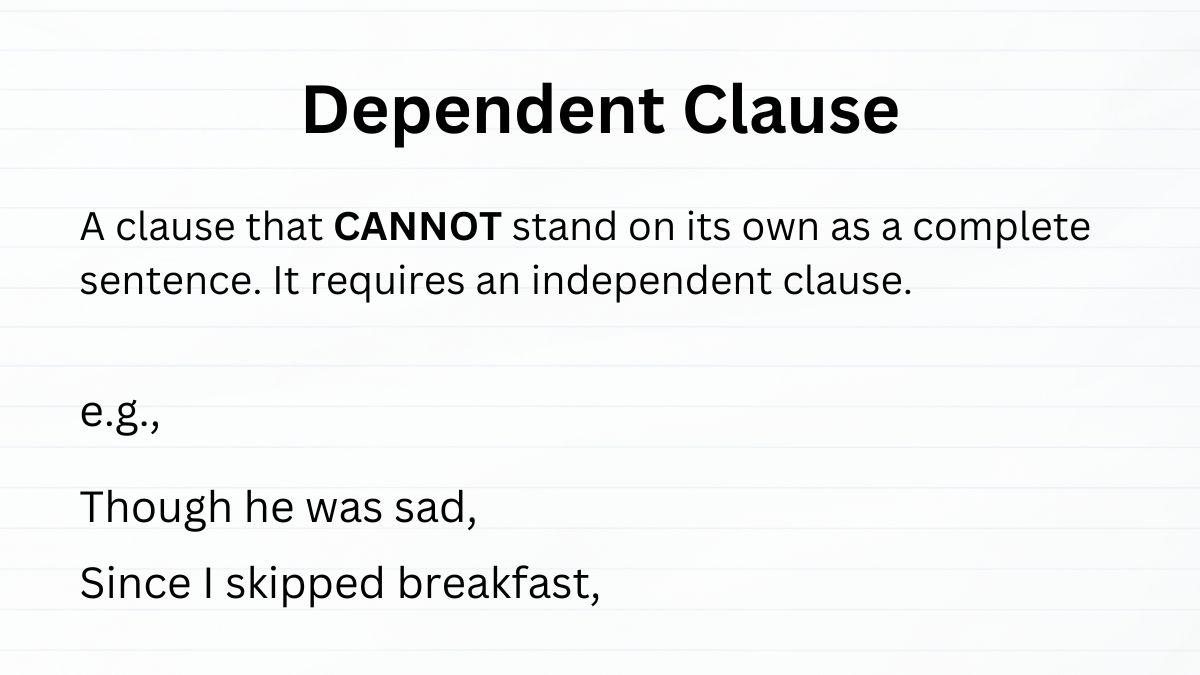
A dependent clause, by contrast, is a clause that can’t stand alone as a sentence. It needs another independent clause to form a complete sentence.
Though it was a cold day, a boy was making a sand castle outside.
Here, the first part, “Though it was a cold day,” is a dependent clause. It has a subject and a verb, but it doesn’t form a complete thought on its own. If you stop the sentence there, the meaning is incomplete.
A dependent clause becomes part of a full sentence only when it is joined with an independent clause. Even so, because it still has both a subject and a verb, it’s still considered a clause.
Clause is Different from Phrase

What if a group of words doesn’t have both both a subject and verb? Usually, there are many cases where a set of words missing a verb.
Some mistakenly think that anything that cannot stand alone as a sentence is a dependent clause. That’s not correct.
By definition, a clause must include both a subject and a verb. Whether it can stand alone as a complete sentence doesn’t affect that definition. If a group of words is missing either part, it’s called a phrase, not a clause. Let’s look at an example:
Eating a lot
This is a phrase, not a clause, because it doesn’t have a true verb. That alone tells you it can’t stand as a clause.
Notice that the opening word “eating” isn’t functioning as a verb here. When “-ing” is added to a verb, it often becomes a gerund, which behaves like a noun, unless it’s part of a progressive tense (e.g., He is eating dinner.)
You can see that a gerund behaves like a noun by looking at this sentence:
Eating a lot is bad for your health.
Here, the gerund phrase “eating a lot” acts as the subject of the sentence, followed by the verb “is” and the complement “bad.” Only a noun can function as the subject, so this shows that a gerund clearly works as a kind of noun.
Summary: Independent and Dependent Clauses
Let’s sum up how independent and dependent clauses work in a sentence.
- Independent clause: Can stand alone as a complete sentence.
- Dependent clause: Needs an independent clause to form a complete sentence.
The key difference is whether the clause makes sense on its own. If the clause is incomplete by itself, it’s a dependent clause. In contrast, if it expresses a complete thought, it’s an independent clause.
Practice Questions
Now, let’s test your understanding of independent and dependent clauses.
Question 1

Question 2
Question 3
About the Author: joe